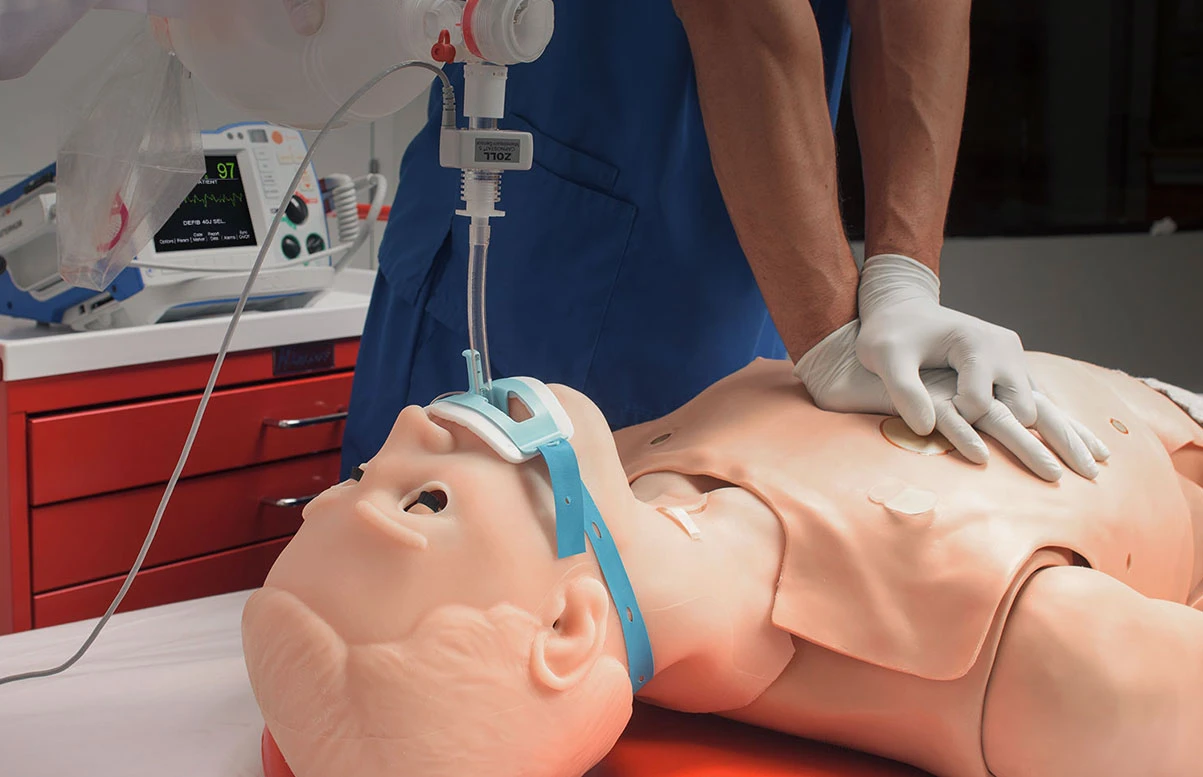
HAL® S3201 Advanced Multipurpose Patient Simulator
The HAL® 3201 simulator sets a global standard for medical human patient simulation. Tetherless simulator technology allows the communications, compressor, and power supply to be inside HAL®, eliminating external tubes, wires, and compressors. HAL® operates continuously during transport and training can occur in the working environment. Rush HAL® from the accident scene to the ER, to the ICU, while care providers diagnose and treat his condition using real monitoring and resuscitation equipment. Control HAL® at distances up to 900 Ft. (300 m) and between rooms and floors of conventional buildings. HAL® smoothly transitions between physiologic states in response to commands from a wireless PC.
The HAL® 3201 simulator sets a global standard for medical human patient simulation. Tetherless simulator technology allows the communications, compressor, and power supply to be inside HAL®, eliminating external tubes, wires, and compressors. HAL® operates continuously during transport and training can occur in the working environment. Rush HAL® from the accident scene to the ER, to the ICU, while care providers diagnose and treat his condition using real monitoring and resuscitation equipment. Control HAL® at distances up to 900 Ft. (300 m) and between rooms and floors of conventional buildings. HAL® smoothly transitions between physiologic states in response to commands from a wireless PC.
- Product Features General Tetherless and wireless; fully responsive during transport1 Fully operational on internal battery power for up to 6 hours2 Supports common patient positions including Fowler’s, supine, and sitting Airway Programmable airway: tongue edema, laryngospasm, and pharyngeal swelling Multiple upper airway sounds synchronized with breathing Right mainstem intubation Sensors detect depth of intubation Placement of conventional airway adjuncts Endotracheal intubation Retrograde intubation View vocal cords with Sellick maneuver Realistic surgical trachea allows tracheostomy or needle cricothyrotomy Circulation Measure blood pressure by palpation or auscultation Use real BP cuff rather than a “virtual” cuff to measure blood pressure Korotkoff sounds audible between systolic and diastolic pressures Oxygen saturation detected using real monitors rather than a “virtual” value Pulse sites synchronized with BP and heart rate Bilateral IV arms with fill/drain sites SubQ and IM injection sites Intraosseous access at tibia ECG monitoring using real devices Defibrillate, cardiovert, and pace using real devices Multiple heart sounds, rates, and intensities ECG rhythms are generated in real-time Bilateral carotid, radial, brachial, femoral, popliteal, and pedal pulses synchronized with ECG Pulses vary with blood pressure and are continuous and synchronized with the ECG, even during a paced rhythm Breathing Control rate and depth of respiration and observe chest rise Select independent lung sounds: upper right, front and back; upper left, front and back; lower right, front and back; lower left, front and back Chest rise and lung sounds are synchronized with selectable breathing patterns CO2 on exhalation (4 levels) using replaceable cartridge mounted inside the simulator Attach to real mechanical ventilators Bilateral chest rise and fall Unilateral chest rise simulates pneumothorax Anterior and posterior auscultation sites Bilateral needle decompression at second intercostal Dynamic airway and lung compliance/resistance Ten levels of static compliance, 15-50 mL/cm H2O Ten levels of airway resistance Holds PEEP from 5 to 20cm H2O Exhales real and measurable CO2 Receive real-time feedback from a real mechanical ventilator Capable of assisting the ventilator at variable respiratory rates Compliance and resistance can be varied while connected to the ventilator Cardiac ECGs are generated in real-time with physiologic variations never repeating textbook patterns Heart sounds may be auscultated and are synchronized with ECG Real-time CPR feedback: compressions and ventilations are measured and logged 12-lead ECG with integrated MI model Speech Wireless streaming audio Create and store vocal responses in any language Drug Recognition System Automatic drug recognition detects medication type, dose, and rate injected into the lower right arm Includes a pre-programmed library of virtual medications Supplied with 20 syringes wireless tags Add new medications using the UNI software editor Neural Responses Eyes are controlled automatically by the physiologic model or directly by the instructor Select pupillary response to light Vital Signs Monitor Controlled via wireless tablet PC Use selected configuration or create your own configuration to mimic the real monitors used in your facility Share images such as ultrasounds, CT scans, and lab results Touchscreen control Monitor can be configured by the instructor to suit the scenario Articulation Movement Realistic joint articulation Supports supine, prone, recumbent, and sitting positions Seizure/convulsions UNI® 3 Interface Sensors track student actions Changes in condition and care provided are time-stamped and logged Pre-programmed scenarios that can be modified by the instructor even during the scenario Create your own scenarios (add/edit) Change the simulator’s condition during the scenario Other Central cyanosis Fill bladder and perform Foley catheterization Male urinary catheterization with fluid return Supports placement of nasogastric tube Auscultate bowel sounds
—
No documentation added yet.
—
Related products